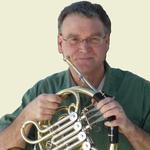
Richard Burdick is the first horn of Regina Symphony Orchestra and the Regina Symphony Chamber Players in Regina, Saskatchewan, Canada. He is a prolific composer.
His move to Canada in 2003, with his wife Rebecca and his two boys, marked the start of the fourth major period in his musical Career.
In the 1980’s Richard was first Horn of Napa Symphony, a member of a San Francisco based theater orchestra and played lots of chamber music as manager of Trinity Chamber Concerts, a chamber music series in Berkeley California.
Starting in 1990 he played fourth Horn full-time for Sacramento Symphony, which went bankrupt in 1996.
He then won auditions for Fresno Philharmonic, Napa & North State Symphonies and played in Sacramento Philharmonic & Opera.
He is a prolific composer and has many self produced CD’s of his own compositions, Bach, his classical natural horn playing and multi-track performances of many of his favorites pieces.
He performs on a variety of horns, a baroque natural horn (1720), a classical era natural horn(1800), a romantic era (1840's) natural horn, a single F horn from the 1880's, his main symphony horn is a Brennan Model Finke double horn and he sometimes plays his C. F. Schimdt double horn made in 1934, which was played by James Tankersley priciple hornist of the Houston Symphony during the 1950's-1960's.
Richard Burdick is a prolific composer of chamber and orchestral music. He has a large volume of works for chamber music settings and concert halls, many of which feature prominent French horn parts.
He frequently uses the I Ching as a structural foundation to his music.
His works vary from quite tonal to improvisational and avant-garde. They also range from minimal to quite random. He has written minimal styles both in the highly sustained and highly repetitive types. His works are very creative, but often have forms and structures that Bach used.
His variety of works fall into the categories of: avant-garde, expressionist, minimalistic, micro-tonal, modernist, neo-classical, and new-age-meditation styles.
His use of harmonies is generally freer and is freeing to listen to. He is developing a New-age-meditation style of music based on the vibratory spectrum of sound.
Since 1980, composer Richard Burdick has been using I Ching inspired scales as a foundation for his compositions. The I Ching is sort of a fortune telling system of the ancient Chinese. Being a binary system, it suggests scale intervals of either half steps or whole steps. It is ideal for scales structures and patterns in music.
Like the scales of Northern India, the scales are divided into two tetra-chord like sets of three intervals. Mr. Burdick uses the perfect fifth to separate the two sets of three intervals. He also has a complete system of fixed tones for each scale that organize the whole system into 64 unique vibratory signatures.
Richard has worked professionally as a transcriber and/or arranger for the Sacramento Symphony, Concord Pavilion Pops Orchestra and others. He has been a recipient of Meet The Composer funding, Concert sponsorship funding from the city of Davis, California, and was the winner of the 1983 Kensington Symphony Composition Contest with his "Six Medieval Fragments for Orchestra, opus 14."
Mr. Burdick began composing in 1975 and has had premieres of most of his compositions.