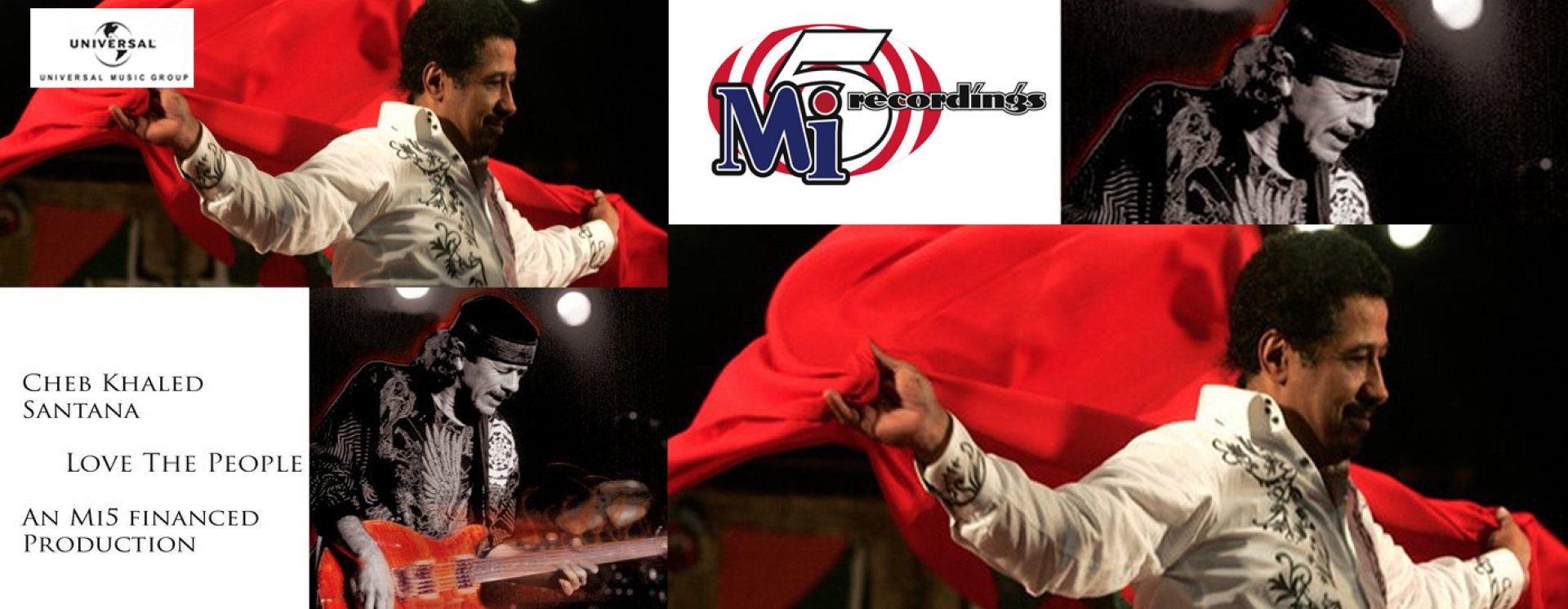
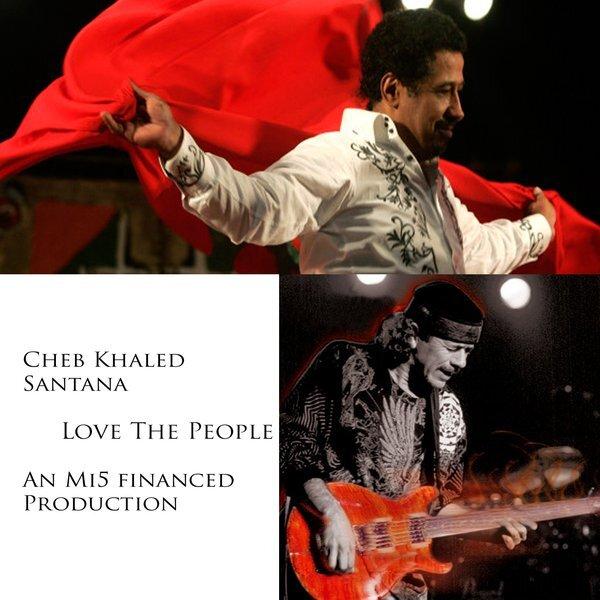
Mi5 Recordings produced/financed the 2004 Grammy jam Awards (Khaled and Carlos Santana) ("Love to the people”)
Cheb Khaled is the King of Rai and is an international star selling roughly 80 million records worldwide. Khaled Hadj Brahim was born in 1960 in Oran's Eckmühl neighborhood, Algeria. At the age of 14, he founded the Cinq Étoiles (Five Stars) band and started performing in nightclubs and at weddings.
In the 1980s, Khaled started producing and singing songs in the Raï genre. He moved to France in 1986.
On 12 January 1995, Khaled married Samira Diabi, 27, with whom he has four daughters and one son.
In 1998, the documentary Khaled: Derrière le sourire was produced, recounting his life.
He was awarded Moroccan citizenship in August 2013, which he didn't ask for but accepted because he felt he could not refuse.
Khaled's signature song, the 1993 hit "Didi", became extremely popular in the Arabic-speaking countries and also in several other continents, including Europe, where it entered the top charts in France, Belgium and Spain, and in Asia, including India and Pakistan. The song was also used in Bollywood films Shreeman Aashiq and Airlift and a Mollywood film titled Highway. Khaled and producer Don Was appeared on The Tonight Show on 4 February 1993. The track, which saw heavy rotation on MTV Europe, climbed to fourth on the charts in Germany.
Known as “The "King of Rai”, Khaled is a winner of numerous awards, and has sold over 80.5 million albums worldwide including 10 diamond, platinum, and gold albums. In 2010 he performed “Didi” at the opening ceremony of the 2010 FIFA World Cup in South Africa, making him one of the best-selling Arabic language artists in history. Khaled's music also experienced great popularity in Brazil, in the late 90's and early 00's, greatly because of the usage of some of his songs in TV shows. In 2012 Khaled's album C’est la vie sold more than one million copies in the European market alone after only two months and sold 2.2 million copies in the Middle East and North Africa, as well as 200,000 in the United States, for an estimated 4.6 million worldwide sales. With a record million downloads of the hit single "C'est la vie" on European and Canadian iTunes, the album reached number 5 on the Billboard top France Songs. The album contains a message of tolerance, love and peace. Khaled tried to convey what Algerian immigrants suffer in Europe through the album and believes this is the reason behind the album's huge commercial success. C’est la vie was Khaled's first album after a five-year break from recording during 2011 presidential elections in France and the Arab Spring.
----
Carlos Santana (born July 20, 1947) is a Mexican and American guitarist who rose to fame in the late 1960s and early 1970s with his band Santana, which pioneered a fusion of rock and roll and Latin American jazz. Its sound featured his melodic, blues-based lines set against Latin and African rhythms played on percussion instruments such as timbales and congas not generally heard in rock. Santana continued to work in these forms over the decades that followed. He experienced a resurgence of popularity and critical acclaim in the late 1990s. In 2015, Rolling Stone magazine listed Santana at number 20 on their list of the 100 Greatest Guitarists. He has won 10 Grammy Awards and three Latin Grammy Awards, and was inducted along with Santana into the Rock and Roll Hall of Fame in 1998.
Santana was born in Autlán de Navarro, Jalisco, Mexico. He learned to play the violin at age five and the guitar at age eight under the tutelage of his father, a mariachi musician. His younger brother, Jorge Santana, also became a professional guitarist. Young Carlos was heavily influenced by Ritchie Valens at a time when there were very few Mexicans in American rock and pop music. The family moved from Autlán de Navarro to Tijuana, the city on Mexico's border with California, and then San Francisco. In October 1966, in San Francisco, Santana started the Santana Blues Band. By 1968, the band had begun to incorporate different types of influences into their electric blues. "If I would go to some cat's room," remembered the guitarist of the band, "he'd be listening to Sly [Stone] and Jimi Hendrix; another guy to the Stones and the Beatles. Another guy'd be listening to Tito Puente and Mongo Santamaría. Another guy'd be listening to Miles [Davis] and [John] Coltrane... . To me it was like being at a university."